
English| EUR
Suggested for you
More currencies
Choose a language
Beneath a single street in Épernay lies a network of chalk galleries deep enough to swallow a small town. This guide sets out what a visit involves, when the doors open, how long you will be below ground, and how to structure the day around a tour rather than squeeze one in.
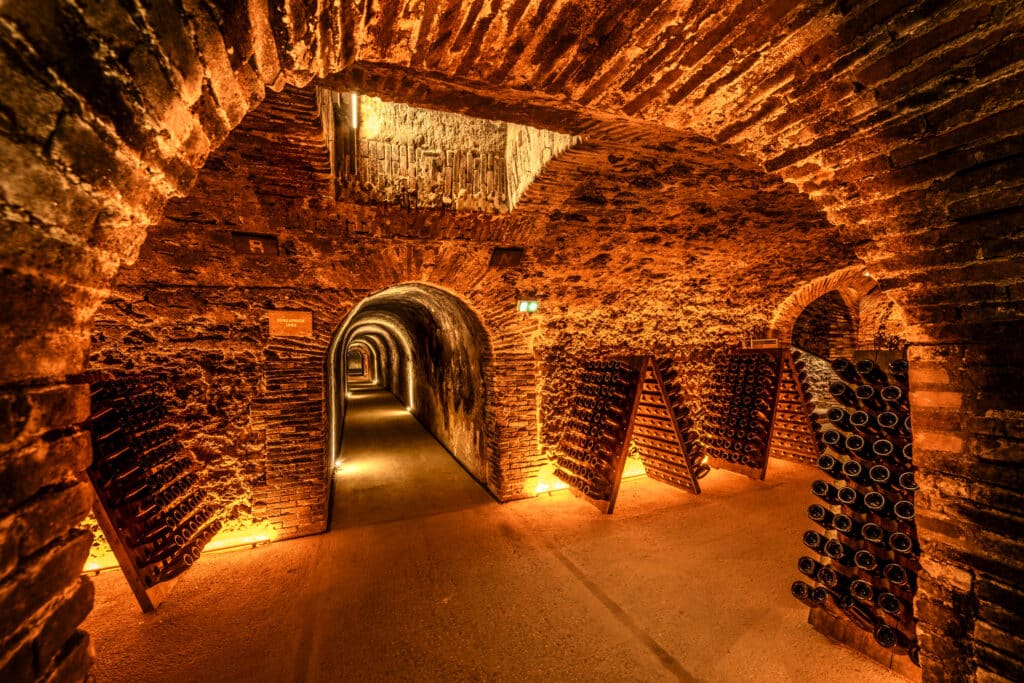
The chalk beneath Épernay was quarried by the Romans, not by winemakers. Only centuries later did the houses of the Marne discover that these cool, humid pits held a constant temperature ideal for the slow second fermentation that turns still wine into Champagne. What began as building-stone extraction became, by the nineteenth century, a subterranean industrial system: kilometres of galleries stacked several levels deep, linked by ramps, lit by gas, and packed with bottles resting on their sides. Epernay cellar tours are the public entrance to that system, and they explain why one provincial town of fewer than 24,000 people holds several hundred million bottles underground. Above ground, the setting is deceptively quiet. Avenue de Champagne is a straight run of nineteenth-century mansions and wrought-iron gates, each façade belonging to a house whose real estate is vertical rather than horizontal. Visitors arrive expecting vineyards and find instead a boulevard, which is why the street was inscribed on the UNESCO World Heritage list in 2015 as part of the Champagne hillsides, houses and cellars. A guided cellar visit in Épernay generally follows the same arc: a short introduction in the reception hall, a descent by staircase or lift into the crayères, a walk past riddling racks and stacked bottles at roughly 10 to 12 degrees Celsius, an account of pressing, assemblage, remuage and dégorgement, then a tasting on the way back up. Comfortable shoes and a jacket matter more than most guides admit; the temperature difference in August is considerable. The pace of the visit is the thing to plan around. Readers weighing several houses against one another should treat one morning visit as a complete half-day commitment rather than an item on a list, then use the afternoon for the street itself, the Portes Saint-Martin quarter, or the vineyard road toward Hautvillers. Use the detail below to build the day in order: check the daily schedule first, then the fee structure, then the arrival window, then the route in from Reims, Paris or the station on Place Mendès-France. Booking ahead is standard practice for epernay cellar tours in high summer, when English-language departures fill first and walk-in slots are the exception rather than the rule.
“One provincial town of fewer than 24,000 people holds several hundred million bottles underground.”
The best arrival window is 09:30–15:30. Arriving early avoids peak afternoon crowds and ensures sufficient time for the 90-minute tours.
—
These sessions offer the quietest experience for exploring the cellar networks.
Warm, averages 20°C to 25°C
Peak tourism occurs during July and August, requiring advance planning.
Cooler, averages 10°C to 16°C
Harvest season adds local activity and pleasant temperatures for cellar visits.
—
Tours nearing the final entry slot experience higher density than morning arrivals.
Verdict: Tuesday to Thursday, arriving at 09:30, during the months of April or October provides the optimal balance of lower crowds and manageable weather.
Cellar tours on the Avenue de Champagne run on fixed timed slots, so a few decisions need settling well before you arrive.
Everything you need to know about epernay cellar tours
Guests typically explore historical limestone galleries to learn about the traditional methode champenoise production process. These epernay cellar tours conclude with an individual tasting led by a professional host. You will discover how still wine undergoes secondary fermentation in the bottle to become sparkling wine.
Due to high demand for these popular Epernay attraction tours, it is advisable to secure your spot as early as possible. Booking online ensures availability for your preferred date and time slot. Same-day walk-ins are frequently unavailable during peak season.
Photography is generally permitted for personal use in most areas, though flash may be prohibited to protect the environment of the chalk pits. Please respect the guidelines provided by your guide regarding equipment use near the vintage reserves. This ensures a seamless experience for all participants during epernay cellar tours.
Moet & Chandon Champagne Tour
Read more Tickets & toursPrivate Epernay Champagne Tours
Read more GuideChampagne Houses in Epernay Open to Public
Read more Tickets & toursEpernay Champagne Tours from Paris
Read more Tickets & toursEpernay Champagne Tours from Reims
Read more Tickets & toursEpernay Champagne Bike Tours
Read more Tickets & toursEpernay Champagne Houses Tour
Read more